
Cryptocurrency
What Is Crypto Processing — How to Choose and Which One to Connect
#faq
Accepting cryptocurrency payments is no longer exotic. Online stores, online schools, and SaaS services are adding payment options in Bitcoin and USDT alongside bank cards. But to accept crypto, you need technical infrastructure — and that raises the question of what crypto processing means and why a business needs it. Let's break down how crypto processing services work, what types exist, and how to choose the right solution for your needs.
What Is Crypto Processing and How It Works
Crypto processing is a system for handling cryptocurrency payments that acts as an intermediary between the buyer and the seller. The service handles the technical side — generating addresses, tracking transactions, monitoring confirmations, and sending status notifications.
To explain what crypto processing is in simple terms — it's the equivalent of bank acquiring, only instead of Visa and Mastercard cards, it processes Bitcoin, Ethereum, USDT, and other digital assets. The buyer pays with crypto, and the seller receives funds in a convenient format — either the same crypto or in stablecoins.
The working principle looks like this. The customer selects a product and specifies cryptocurrency as the payment method. The system generates a unique address for this payment and shows a QR code with the amount. The customer scans the code and sends funds from their wallet. The crypto processor tracks the transaction on the blockchain, waits for confirmations, and notifies the store of the incoming payment. The order automatically moves to "Paid" status.
The entire process takes anywhere from a few seconds to an hour depending on the network. The seller does not need to manually check the blockchain and match transactions to orders — the system does this automatically.
What Types of Crypto Processing Exist
Crypto processing services differ in their operating model and functionality. The choice depends on the business's needs, technical capabilities, and requirements for control over funds.
Centralized Solutions
Centralized crypto processing works through a single provider. You register with the service, connect the integration, and the provider handles all payments, stores funds, and ensures withdrawals.
The advantages of this approach are obvious. Fast setup via ready-made plugins or API. Technical support resolves issues on your behalf. Automatic conversion to stablecoins protects against volatility. A single interface for managing all payments.
Centralized solutions suit most businesses — from small online stores to large platforms. Especially convenient for those who don't want to get into the technical details of blockchain.
There are limitations too. A service commission on each transaction. The need to trust the provider with fund storage. Possible business verification requirements.
Decentralized Solutions
The decentralized approach involves accepting cryptocurrency directly into your own wallet without intermediaries. Funds go straight to your address, bypassing a third party.
Direct wallet acceptance is the simplest option. You publish an address on your website, the client transfers funds, and you manually verify the receipt. The advantage is no service commission and full control over assets.
Smart contracts are a more advanced option. A program on the blockchain automatically verifies the amount and sends a confirmation to your system. This requires code development and auditing, but provides automation without a centralized intermediary.
Decentralized solutions suit technically prepared teams with high payment volumes. For most businesses, centralized crypto processing is more convenient and reliable.
Crypto Processing for a Website — How It Works in Practice
Connecting crypto processing to a website takes anywhere from a few hours to a couple of days depending on the chosen integration method.
Website Connection Options
Ready-made plugins — the fastest method. You install a module for your CMS, enter API keys from the processing dashboard, and configure the basic parameters. Setup takes 15–30 minutes without a developer.
API integration — for custom solutions. A developer connects the payment gateway via documented API. This gives full control over the payment process and allows crypto payments to be embedded into any interface. Suitable for mobile apps, non-standard websites, and complex scenarios.
Payment links and forms — an option without development. You create a payment link in the dashboard and send it to the client. Or place a ready-made button on the website.
Our service's payment form is designed so that the client completes the payment. Minimal elements on the screen — just the QR code, amount, address, and timer. Nothing extra that could distract or confuse. The user immediately understands what to do and completes the payment in a few seconds.

Integration with CMS and Online Stores
Most crypto processors offer plugins for popular platforms. Our service supports integrations with Opencart, WHMCS, WooCommerce, Prestashop, Xenforo, and Invision Community. Plugins and connection instructions for each CMS can be found here.

The integration process is straightforward. Download the plugin from the marketplace or the processing website. Install it via the CMS admin panel. Enter the API keys and secret tokens from the dashboard. Configure the list of cryptocurrencies, limits, and notifications. Run a test payment to verify everything works.
After setup, cryptocurrency appears as a payment method at checkout alongside cards and e-wallets. The customer chooses to pay with crypto, the system generates an invoice, tracks the payment, and updates the order status automatically.
Crypto Processing for Business — Key Tasks
Crypto processing solves specific business problems that are difficult or expensive to address with traditional payment tools.
Accepting Payments in Multiple Cryptocurrencies
Ideally, the service should accept popular cryptocurrencies — Bitcoin, Ethereum, USDT on various networks, Litecoin, Solana, and others. The customer chooses a convenient coin, and you receive all payments in a single interface.
Without crypto processing, you would have to create a separate wallet for each cryptocurrency, monitor transactions across different networks, and manually match payments to orders. With high volumes, this turns into chaos.
Automating Settlements and Notifications
Crypto processing automates routine work. The system automatically generates an address for each payment, monitors blockchain confirmations, updates order statuses, and sends webhook notifications to your server.
You configure the rules once — and everything works without human involvement from that point on. Payment received — order marked as paid. Payment time expired — invoice automatically cancelled. Required number of confirmations reached — customer receives their goods.
Reducing Operational Load
Manually processing crypto payments takes hours. Check the blockchain, find the transaction, verify the amount, match it to an order, update the status, notify the customer. With 10 payments a day this is manageable; with 100, you need a dedicated staff member.
Crypto processing removes this burden. The system handles any number of payments equally quickly. You focus on growing the business, not monitoring transactions.
Transaction Control and Accounting
Our service records all payments in the dashboard with a complete history — date, amount, cryptocurrency, network, transaction hash, status, and order reference. You can filter by period or currency.
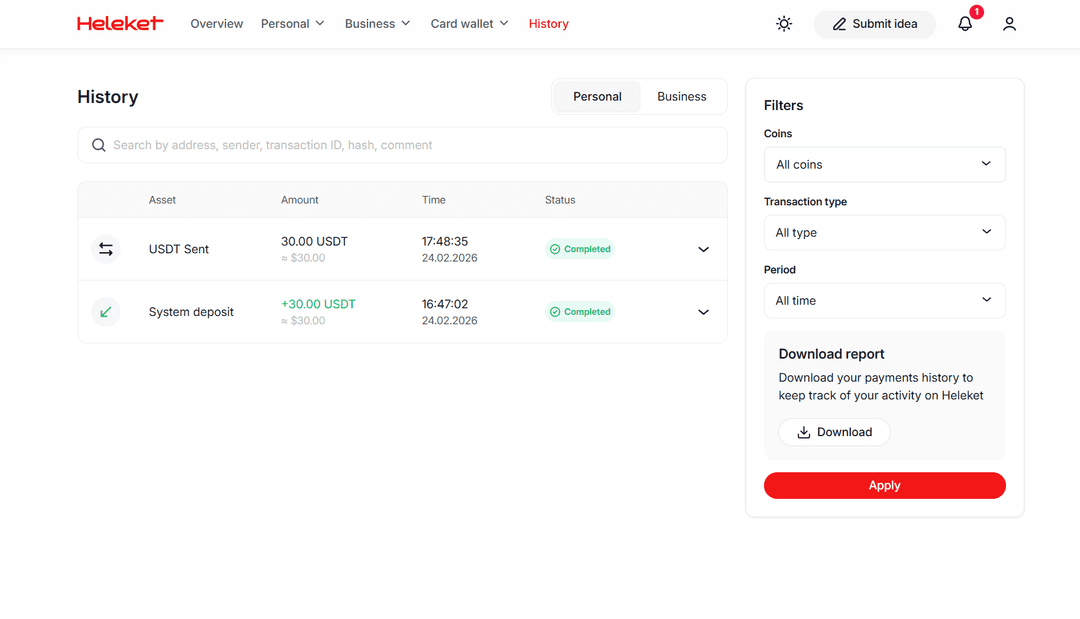
This simplifies accounting and protects you in disputes. A customer claims they paid — you check in the system. You need data for tax purposes — you export a report. Everything is transparent and documented.
Which Crypto Processing to Connect for Your Business
The choice of crypto processing depends on the type of project, payment volume, and the team's technical capabilities.
For Small Websites
Small projects need a simple solution without complex setup. A crypto processor with ready-made plugins for popular CMS platforms, a straightforward interface, and a minimal commission is the right fit.
Selection criteria — availability of a plugin for your platform, no subscription fee, support for basic cryptocurrencies (USDT, Bitcoin), fast registration without complex verification.
For E-commerce
Online stores with high order volumes need reliable automation. API stability, payment processing speed, and support for multiple networks for a single cryptocurrency are all important.
Selection criteria — webhook notifications for automatic status updates, USDT support on multiple networks (TRC-20, ERC-20), auto-conversion to stablecoins, detailed reporting.
For Services and Platforms
SaaS platforms, marketplaces, and subscription services require a flexible API and customization options. Standard plugins are usually not enough.
Selection criteria — comprehensive API documentation with examples, a sandbox for testing, support for recurring payments or subscriptions, bulk payout capability.
How to Choose Crypto Processing for Your Needs
When choosing a crypto processor, pay attention to several key criteria.
Supported Currencies
The minimum set is USDT (ideally on multiple networks), Bitcoin, and Ethereum. This is sufficient for most clients. Additional cryptocurrencies broaden the audience but are not critical at the start.
Pay attention to network support. USDT on TRC-20 is cheaper for the customer than on ERC-20. If the processor only supports one network, some buyers will leave.
Ease of Integration
Assess how long the setup will take. Is there a ready-made plugin for your CMS? How clear is the API documentation? Is there a test mode for debugging without real transactions?
Try registering and going through the basic setup before making a decision. If you encounter difficulties at this stage, there will be more in actual operation.
Fees and Conditions
The standard crypto processing commission is 0.4% to 1% per transaction. Compare the total cost — some services add charges for withdrawals, conversion, or minimum transactions.
Clarify the conditions for your type of business. Some processors charge higher commissions for certain categories or don't work with them at all.
Support and Documentation
Check the support response speed before connecting. Send a test question and time the response. When there are payment issues, getting help quickly is critical.
Study the documentation. It should be written in plain language, with code examples and descriptions of typical scenarios. Poor documentation is a sign of an immature service.
Heleket meets all the criteria listed above — support for popular cryptocurrencies and networks, CMS plugins and documented API, detailed transaction history, auto-conversion to stablecoins, transparent commissions from 0.4%, and responsive technical support. Learn more about the capabilities at https://heleket.com/ru.
Conclusion
Crypto processing turns cryptocurrency acceptance from a technical challenge into a standard business tool. The service handles transaction tracking, confirmation monitoring, notifications, and reporting. You get a ready-made infrastructure without needing to understand the details of blockchain.
The choice of crypto processing depends on the scale of the project. Small websites need a simple solution with a CMS plugin. Online stores need reliable automation and multi-network support. Platforms and services need a flexible API and customization options.
When choosing, look at supported cryptocurrencies, ease of integration, fees with no hidden charges, and support response speed. Test the service with small amounts before a full launch. And remember — crypto processing should simplify your work, not create additional complexity.