
Accepting Cryptocurrency Payments for an Online Store
#crypto-acquiring
Introduction
Cryptocurrency no longer looks exotic on a payment page. Just a few years ago, the option to pay with Bitcoin was seen as a marketing gimmick — now it's a payment method that clients actively seek out. More than 85% of retail companies in the US consider launching crypto payment acceptance a priority task, and three quarters of them plan to implement this payment method in the next couple of years.
Demand from buyers is growing in parallel. Most cryptocurrency holders specifically look for stores where they can pay with digital assets, and many have at least once abandoned a purchase because the website didn't offer that option. For an online store, this means one simple thing — accepting cryptocurrency has stopped being an enthusiast's option and has become a factor that directly affects conversion.
Let's break down what benefits accepting cryptocurrency payments gives an online store, how it can be connected, and what to look for when choosing a service.
Benefits of Accepting Cryptocurrency for an Online Store
Lower Fees
Bank acquiring takes 2–4% from every payment, and international cards add currency spreads and cross-border transaction fees on top of that. Crypto processing operates in a different price range — the average fee level is 0.4–1.5% depending on volume and terms.
On a flow of payments, the difference is significant. A store with a monthly turnover in the millions saves enough on fees that the cost of connecting crypto payments pays for itself in the very first month.
Fast Transactions
A payment on the Tron network is confirmed in 3–5 seconds, on Solana — even faster. Bitcoin takes around 10 minutes, Ethereum — from a few seconds to a couple of minutes. In any of these cases, money reaches the seller faster than through a bank transfer and without dependence on business days.
For an online store, this means instant payment confirmation and the ability to ship the order immediately. The difference is especially noticeable for international sales — where a bank transfer would take three to five days, a crypto payment closes the deal in a minute.
No Intermediary Banks
A blockchain transfer goes directly from the client's wallet to the seller's wallet. There is no acquiring bank, no issuing bank, and no processing center in between that could delay the payment, request documents, or reject the transaction based on their internal rules.
This eliminates the typical risks of acquiring — fund blocking due to fraud suspicions, chargebacks initiated by the buyer, disputes with the payment system. A confirmed blockchain transaction is irreversible and cannot be cancelled.
Automated Settlement
Modern crypto processing integrates into a website in the same way as a regular payment gateway. The client clicks the payment button, selects a cryptocurrency, scans a QR code or copies the address — after that the system tracks the incoming funds itself, verifies confirmations on the network, recalculates the amount at the current rate, and sends the store a notification of successful payment.
Convenience for Digital Goods and Services
SaaS services, online courses, content subscriptions, digital licenses, in-game items — all of this fits perfectly with crypto payment. No physical delivery, no customs, no need to gather documents for currency control. The client pays — they instantly receive access or the product.
Such business models are global by nature — buyers can be anywhere in the world. Cryptocurrency works the same for a client from Argentina, the Philippines, or Canada, and this greatly simplifies scaling the project into new markets.
Main Connection Methods
Crypto Wallet
The simplest option is to register a crypto wallet and place its address on the payment page. The client sends funds directly, and the store receives them in the wallet with no intermediaries or additional commissions.
This method has one advantage — maximum simplicity. The downsides are more numerous. The payment is not linked to a specific order at all, and transactions will have to be reconciled with purchases manually. The client enters the address and selects the network themselves, and an error in either of these fields will result in lost funds. There will be no sales statistics or analytics. With a few orders a day this still works; with a flow of payments, it becomes a nightmare.
This option is only suitable for small stores with occasional sales or for a test launch of crypto payment to gauge whether there's demand for it.
Crypto Processing
Crypto processing is a payment gateway for accepting cryptocurrency that integrates into a website in the same way as familiar card acquiring. In its working logic, it is identical to bank processing — it just uses blockchain instead of card networks.
What connecting crypto processing provides:
- automatic generation of a unique address for each payment;
- tracking of incoming funds on the blockchain and monitoring of the number of confirmations;
- instant notifications to the store about successful payment;
- linking the payment to a specific order in the store's system;
- automatic conversion of cryptocurrency to a stablecoin or fiat at the exchange rate at the time of payment;
- detailed statistics and reporting in the dashboard;
- ready-made integration modules for popular CMS platforms and an API for custom solutions.
For any online store with regular sales, this is the only workable option. Manually handling a flow of cryptocurrency payments is impossible — there are too many technical tasks, each of which processing handles automatically.
Which Cryptocurrencies to Accept
Stablecoins
A stablecoin is a cryptocurrency whose rate is pegged to the dollar or another fiat currency in a 1:1 ratio. The best known are USDT (Tether) and USDC (USD Coin). Their main advantage over regular cryptocurrencies is the absence of volatility. If a client paid 100 USDT for an order, the seller will receive the equivalent of 100 dollars regardless of what is happening in the market.
For an online store, this is the ideal option for several reasons. There is no need to urgently convert crypto revenue into fiat to avoid losing on the exchange rate. Accounting is kept in familiar dollars. Fees on the Tron network for USDT are fractions of a cent, and a transfer takes a few seconds. For all of these reasons, stablecoins have become the primary cryptocurrency for commercial use.
Popular Currencies
Bitcoin and Ethereum are the two most recognizable crypto assets, and some of the audience prefers to pay specifically with them. The main downside is volatility. The BTC rate can change by several percent in a day, and a store that received payment in Bitcoin risks losing part of its revenue if it doesn't convert it immediately.
The problem is solved by auto-conversion — a feature that any decent crypto processing supports. At the moment of receiving a payment, the service instantly exchanges the cryptocurrency for a stablecoin or fiat at the current rate. This way, the store retains the influx of clients who want to pay in BTC or ETH without bearing exchange rate risks.
In practice, the optimal setup is to accept a broad list of cryptocurrencies (BTC, ETH, USDT, USDC, LTC, TRX, and others) and automatically convert all incoming payments to stablecoins.
The Importance of Choosing a Crypto Payment Service
Literally everything depends on the chosen processing — payment confirmation speed, commission size, service reliability, ease of integration, and support quality. A poorly chosen service becomes a bottleneck that slows down the entire business.
What to pay attention to when choosing.
Security level. Two-factor authentication for dashboard access, storage of client funds in cold wallets, data encryption — these are basic requirements. Without them, working with a service is simply dangerous.
Reputation and operating history. It's worth checking reviews, evaluating the company's public activity, and making sure there are no scandals or stories about users losing funds. A young service without a reputation is a high risk.
Convenience for buyers. The payment page should be adapted for mobile devices, support multiple languages, and allow customization to match the store's design. If the client doesn't understand how to pay, they leave.
Supported cryptocurrencies and networks. The broader the list, the larger the audience that will be able to pay. Good processing supports at least 10–15 popular coins.
Ready-made integration modules. Having plugins for WooCommerce, OpenCart, PrestaShop, and other CMS platforms reduces connection time from weeks to hours. If the store was built from scratch, a clear API and documentation are needed.
Support quality. Crypto payments are a technically complex field, and clients will have questions. Fast and competent support is a critical factor.
The service at https://heleket.com/ru covers all of the requirements listed above. It supports accepting a broad list of cryptocurrencies on major networks, offers ready-made modules for popular CMS platforms and an API for custom solutions, automatically converts incoming payments to stablecoins to protect against volatility, and allows withdrawing funds in a convenient way. The virtual card feature deserves separate mention — it allows spending the store's crypto revenue without first withdrawing to fiat.
How to Connect Crypto Payments to an Online Store
The connection process with most modern processing services looks roughly the same and takes from one hour to one day depending on the store's platform.
Step 1. Registering with the service. An email address and password are usually sufficient. Many processing services don't require complex verification at the start — you can proceed directly to setup.
Step 2. Adding a project. Basic details are filled in the dashboard — the store address, a link to the successful payment page, a link to the error page, project name, and contact details.
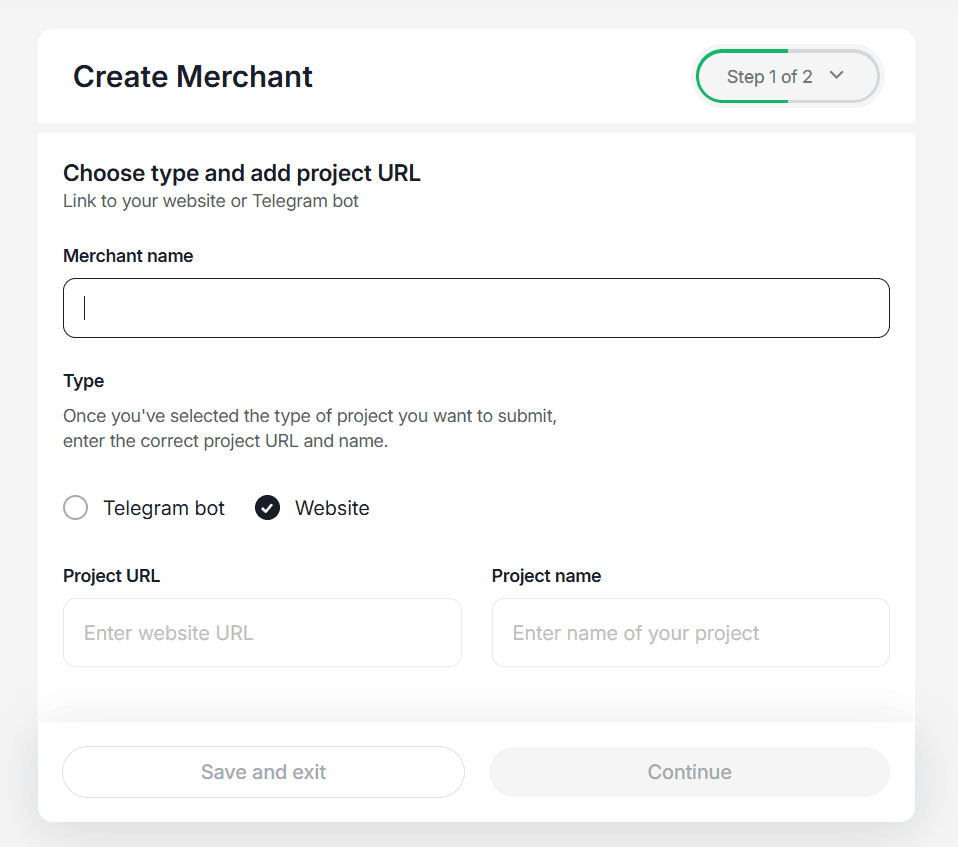
Step 3. Configuring acceptance parameters. Selecting the cryptocurrencies that will be available on the payment page. Enabling auto-conversion to stablecoin if volatility is critical. Configuring notification parameters — the webhook address to which the service will send payment statuses.
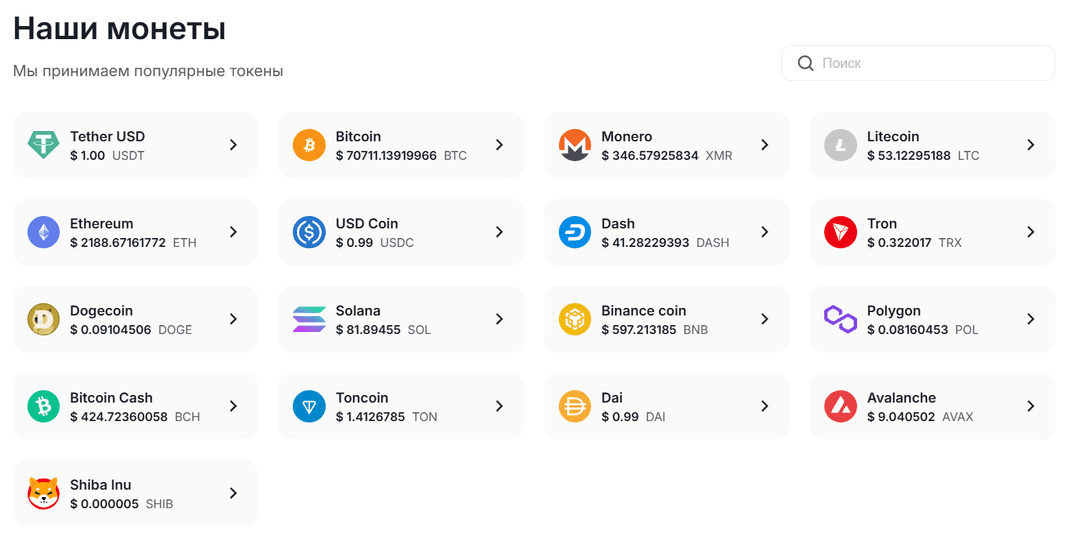
List of cryptocurrencies available for acceptance with Heleket.
Step 4. Integrating with the website. Two paths. The first is installing a ready-made module for the CMS (WooCommerce, OpenCart, PrestaShop, Shopify, and others). The module is installed like a regular plugin and configured through the administration panel. The second is connecting via API for custom-built websites. This requires a developer's help, but offers more customization options.

List of CMS platforms available for connection with Heleket.
Step 5. Test payments. Before launch, it is critical to run several test transactions to verify that — the payment initiates correctly, the amount is recalculated at the current rate, the notification reaches the store, and the order status updates automatically.
Step 6. Setting up fund withdrawals. Determining how money will be withdrawn — to an external crypto wallet, through a virtual card, or to fiat in a bank account. Setting up the withdrawal frequency or doing it manually.
Step 7. Placing information for clients. The payment page needs to clearly show that the store accepts cryptocurrency, list the supported coins, and add a brief guide for those paying with crypto for the first time.
After these steps, the store is ready to accept payments.
How Crypto Payments Work
Before launching crypto payment acceptance, it's important to understand several technical aspects that distinguish blockchain from the banking system.
Transaction irreversibility. A confirmed blockchain payment cannot be cancelled. This is an advantage for the seller — no chargebacks or return payments initiated by the client. But this also requires care when processing agreed-upon refunds — the money will need to be sent in a separate transaction manually or through the processing's refund function.
Network selection. The same cryptocurrency can operate on different blockchain networks. For example, USDT exists on Ethereum (ERC-20), Tron (TRC-20), BNB Smart Chain (BEP-20), and others. If the client sends USDT through one network and the store is expecting it on another — the money will either be lost or require complex recovery. Good processing generates addresses for a specific network itself and guides the client on exactly where to send funds.
Network fees. The transaction fee is paid by the sender, but it depends on the network. On Tron and Solana — fractions of a cent; on Bitcoin and Ethereum — from a few cents to several dollars depending on network load. When stablecoins on TRC-20 are enabled, transfers become essentially free for the client, which removes one of the possible barriers to payment.
Confirmation time. A payment is considered accepted after a certain number of confirmations on the blockchain. For USDT on Tron, one confirmation is enough, which occurs within a few seconds. For BTC, processing services typically wait for 1–3 confirmations — that's 10–30 minutes. The confirmation count setting affects the balance between speed and security — fewer confirmations give faster processing, more confirmations provide the guarantee that the transaction won't be rolled back.
Volatility. BTC, ETH, and other non-stable cryptocurrency rates change every minute. Without auto-conversion, a store might receive a $100 payment and find a couple of hours later that its crypto revenue is now worth only $95. Auto-conversion to USDT at the moment of receiving the payment completely eliminates this risk.
Conclusion
Accepting cryptocurrency has stopped being a technological novelty and has become a working tool for e-commerce. It reduces fees, speeds up payments, expands the sales geography, and opens access to an audience that specifically looks for stores with crypto payment capability.
For occasional sales, a simple crypto wallet will do, but once a store has a consistent order flow — crypto processing is needed. It takes care of all the technical work, from address generation to currency conversion, and leaves the store owner with only business management.
The key to a successful launch is choosing the right service. A reliable processing service with transparent rates, a broad list of cryptocurrencies, ready-made integration modules, and quality support pays for itself quickly and works like a regular payment gateway — invisibly and without failures. It is in this configuration that crypto payments give an online store the maximum advantages.


